Cement-based flooring, as a durable, economical and versatile solution, is widely used in industrial, commercial and decorative projects. In the following, we will introduce and review the types of these flooring, their features, advantages and applications.
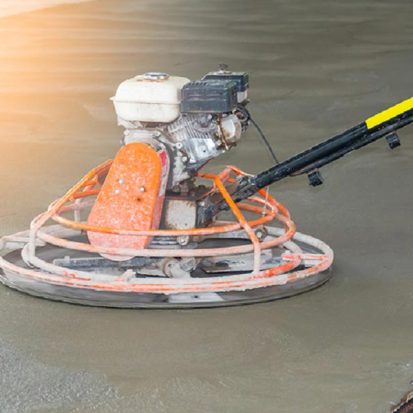
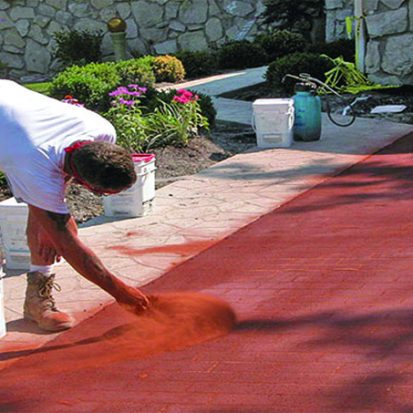
Powdered hard concrete is a combination of cement, hard mineral aggregates, pigments and special additives that is sprayed in powder form on fresh concrete and finished with a butterfly trowel.
High abrasion and pressure resistance
Anti-slip and dustproof
Variety of colors and beautiful appearance
Suitable for indoor and outdoor spaces
Parking lots, warehouses, ramps, sidewalks and public spaces.
The use of powdered hard concrete is an ideal option for high-traffic environments due to its fast implementation and high resistance to mechanical loads and heavy traffic.
This type of flooring not only creates a uniform and seamless surface, but also contributes to the visual beauty of the environment due to the use of resistant pigments.
Low maintenance costs and long-term durability make this flooring very cost-effective for long-term construction projects.
Balanced concrete is a type of cement flooring that creates a beautiful and resistant surface using decorative aggregates and pigments.
High resistance to abrasion and pressure
Beautiful and decorative appearance
Suitable for high-traffic spaces
Shopping malls, exhibitions, lobbies and public spaces.
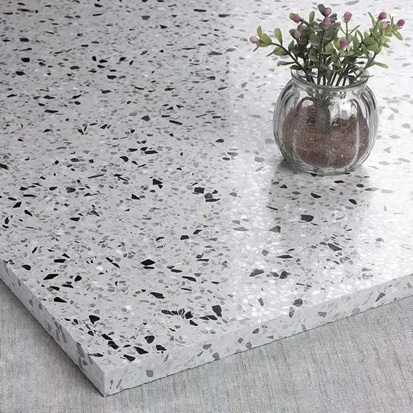
Terrazzo concrete gives a special look to the environment due to its shiny, smooth appearance and eye-catching combination of colored aggregates.
Its implementation requires high precision and final finishing with specialized tools to maintain the shine and evenness of the surface.
Also, its high resistance to impact and abrasion makes it a suitable option for spaces with high traffic or decorative use.
This flooring is usually protected with glossy final coatings to maintain its durability and beauty.
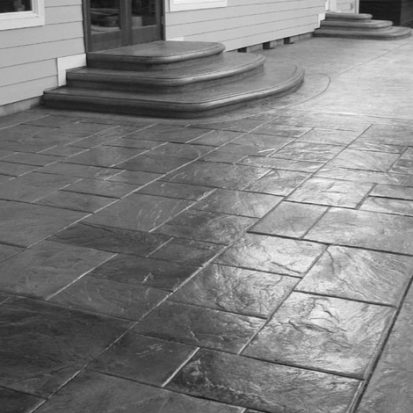
Decorative or stompy concrete creates various designs and textures on the concrete surface using special molds.
Features:
Variety in design and color
High resistance to weather conditions
Anti-slip and washable surface
Landscaping, sidewalks, parks, villas and pools.
This type of flooring is designed to beautify outdoor areas and open spaces and can create a unique look by imitating natural textures such as wood, stone, brick or even tile.
Its correct implementation requires technical knowledge in molding, color combination and surface sealing.
In addition to its beautiful appearance, stamped concrete has a performance resistant to water penetration and sunlight, which makes it a durable option for outdoor environments.
Hard mortar concrete is a cement mortar with hard aggregates that is applied seamlessly over new or old concrete.
Features:
Very high compressive and abrasion resistance
Anti-slip and dust-proof
Resistant to chemicals and heat
Long life and easy maintenance
Factories, warehouses, multi-storey car parks, power plants and heavy industries.
Mortar-hardened concrete is one of the most widely used options in heavy industrial environments, as it is able to withstand dynamic and static loads well.
Its uniform and resistant structure prevents surface cracks and reduces repair costs.
Also, in spaces exposed to chemical spills, this type of flooring performs well with its high resistance and increases productivity and safety in the workplace.
Low-thickness polymer concrete is a combination of modified cements and reinforcing polymers that is applied in a thickness of 10 to 30 mm on concrete substrates.
Excellent adhesion to the substrate
High resistance to pressure, bending and abrasion
Suitable for renovating industrial surfaces in the shortest possible time
Pore-free and impenetrable surface
Renovation of industrial surfaces, production halls, warehouses and decorative spaces.
Low-thickness polymer flooring is an ideal choice for concrete surface renovation and improvement projects due to its low weight and quick implementation.
This type of flooring has excellent mechanical performance even at low thickness and can provide an integrated, crack-free surface that is resistant to water and chemical penetration.
Since its implementation does not require the destruction of previous surfaces, it is very effective in reducing the time and cost of projects and is considered a new option for industrial projects and modern architecture.
Choosing the right type of cement-based flooring depends on the project needs, environmental conditions and budget.
By considering the features and uses of each type, you can choose the best option to increase the durability, beauty, and efficiency of the space.

Behsazan Company started operating in 1993 under the management of Amir Sepasi, and is now at your service by offering products such as concrete types, concrete surfaces, concrete additives, fibers, etc.
Kolahdouz Street (Dolat) after Dolat Gas Station, not reaching Kaveh Boulevard, No. 326, 4th floor, Unit 12