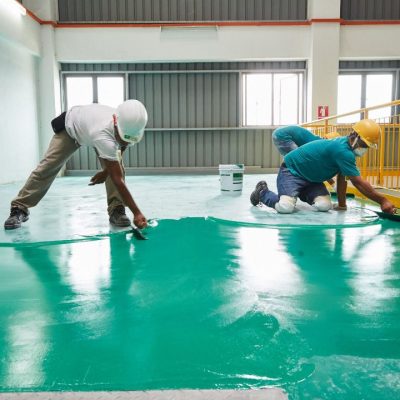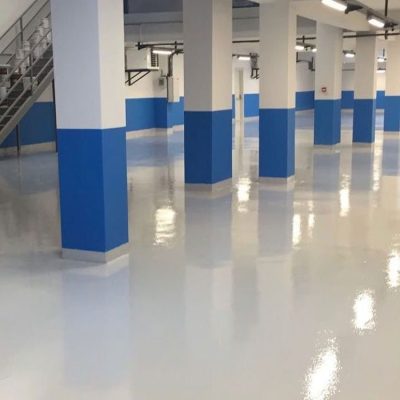
Resin-based flooring, especially polyurethane and epoxy types, are the most popular options for covering industrial, commercial and residential surfaces.
These floorings are used in various projects due to their technical features, high durability, resistance to various conditions, as well as the aesthetic effects they give to the environment.
Below, we will guide you in choosing the best option for your needs by taking a deeper look at the structure, performance, advantages, disadvantages and applications of these floorings.
Chemical composition and structure of epoxy flooring
Epoxy flooring is made from a combination of two main components, including epoxy resin and a polyamine hardener.
This chemical reaction, after mixing, results in a hard, highly adhesive and integrated surface.
This flooring is usually applied in a thick layer and has a matte to semi-gloss appearance.
Epoxy is a popular choice in heavy and semi-heavy industries due to its impermeability and ease of application.
Polyurethane flooring is also produced from a combination of polyurethane resin and isocyanate hardener.
The result of this combination is a product with high flexibility and high resistance to environmental factors such as ultraviolet (UV) radiation, abrasion and cracking.
The appearance of this flooring is often shiny and smooth, and due to its elasticity, it performs better than epoxy in spaces where there are temperature changes or vibrations.
Advantages
Advantages of epoxy flooring
Epoxy flooring is an ideal option for places exposed to high pressure and traffic due to its compact and hard structure.
High resistance to chemicals including acids, alkalis and oils makes it very suitable for use in the chemical and automotive industries.
Its smooth, seamless surface, in addition to being beautiful, is easy to clean and prevents the penetration of pollution.
On the other hand, its long service life and low maintenance cost make epoxy a cost-effective choice.
Polyurethane is flexible and, for this reason, is a more suitable choice in environments where there is a possibility of vibration or movement of the surface.
One of its biggest advantages is its resistance to direct sunlight and lack of color change over time.
It is also very resistant to abrasion, impact and cracking.
With its glossy appearance and variety of colors, this flooring is widely used, especially in the interior design of commercial, residential and entertainment centers.
Disadvantages
Disadvantages of epoxy flooring
Despite its suitable technical characteristics, epoxy flooring is not resistant to UV rays and will change color or yellow over time, especially if installed outdoors.
On the other hand, in humid environments, it can peel and separate from the underlying surface unless proper underlayment and moisture removal is done.
Also, its curing and drying process is time-consuming and requires controlled environmental conditions.
Disadvantages of polyurethane flooring
Polyurethane is also very sensitive to moisture before application and may bubble, wrinkle, or reduce adhesion if the surface is not properly prepared.
Economically, this type of flooring is usually more expensive than epoxy. It is also less resistant to some very strong chemicals than epoxy, although this does not have a noticeable effect in most applications.
Applications
Epoxy flooring applications
Epoxy flooring is a suitable choice for industrial spaces such as factories, warehouses, raw material warehouses, cold stores, and multi-storey car parks due to its high mechanical and chemical resistance.
It is also widely used in medical and health centers such as hospitals and laboratories due to its easy disinfection capability.
Stores and shopping malls also benefit from its benefits for hygiene control and durability.
Polyurethane is used in projects that require a beautiful appearance, resistance to sunlight, and high flexibility.
Including modern commercial spaces, sports centers, exhibition halls, residential homes, offices, and even outdoor areas such as parking lots. Its anti-slip and sound-absorbing properties have also made it very popular in high-traffic spaces.
To achieve the best performance from resin flooring, it is essential to observe the following points:
Preparation of the subfloor: The surface must be completely dry, free of grease and dust. If there are cracks or unevenness, they must be repaired first.
Environmental Control: The ambient temperature and humidity should be within the range recommended by the manufacturer so that the resin curing process is not disrupted.
Use of safety equipment: Resin materials may be harmful if they come into direct contact with the skin or if vapors are inhaled. The use of gloves, masks, and safety glasses is essential.
Order of application of layers: Usually includes a primer (base layer), an intermediate layer, and a final layer, each of which plays a specific role in the resistance and beauty of the flooring.
When choosing between epoxy and polyurethane flooring, you should pay attention to the functional needs, environmental conditions, budget, and type of space use.
Epoxy, with its high resistance and lower cost, is suitable for industrial spaces and places where beauty is not a priority.
In contrast, polyurethane, with its better appearance and greater resistance to light and environmental changes, is a suitable option for modern, high-traffic environments.
Both types of flooring, if applied correctly, can provide years of optimal, trouble-free performance.

Behsazan Company started operating in 1993 under the management of Amir Sepasi, and is now at your service by offering products such as concrete types, concrete surfaces, concrete additives, fibers, etc.
Kolahdouz Street (Dolat) after Dolat Gas Station, not reaching Kaveh Boulevard, No. 326, 4th floor, Unit 12